Ground-Penetrating Wi-Fi: 100m Range for Underground Rescue
Sarah Mitchell ·
Listen to this article~4 min
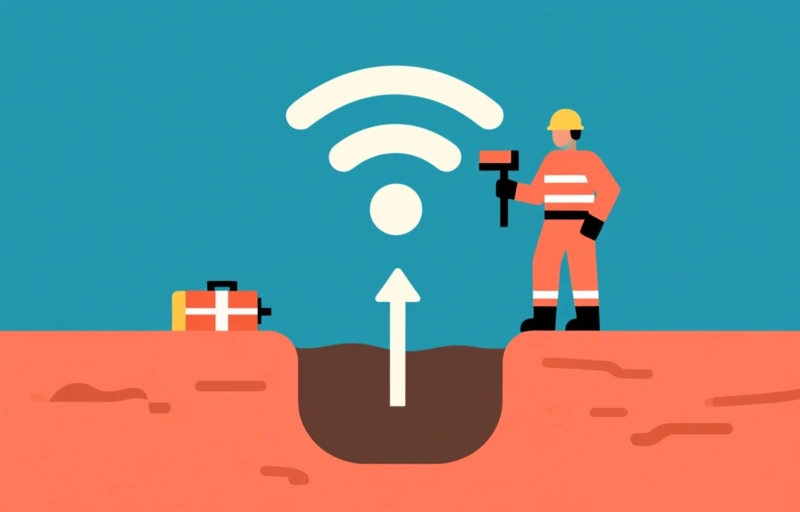
Researchers have developed a ground-penetrating wireless technology using magnetic induction, achieving a 100m range to communicate with people trapped underground, revolutionizing search and rescue.
You know how regular Wi-Fi just gives up when there's a wall in the way? Imagine a signal that doesn't just go through walls, but pushes right through the ground itself. That's exactly what researchers have been cooking up—a kind of 'Wi-Fi' that can reach people trapped or lost deep underground. It's not magic, though it sure sounds like it. It's all about using magnetic fields instead of radio waves, and the potential here is genuinely staggering.
### How Magnetic Induction Changes the Game
Traditional wireless signals, the ones that give us our Netflix and emails, use radio waves. They're great until they hit something solid, like dirt, rock, or concrete. Then they get absorbed or bounce right off. This new tech takes a completely different path. It uses magnetic induction, which is a fancy way of saying it creates a magnetic field to carry data. Think of it like an invisible, digital lasso that can snake through solid materials that would stop a radio wave dead in its tracks.
It's a bit like how wireless chargers work for your phone—they use a magnetic field to transfer power over a tiny gap. Now, scale that idea up to a range of over 300 feet and swap power for a data connection. Suddenly, you have a lifeline that can reach miners, cavers, or disaster victims buried under rubble. The team behind this says their method can maintain a stable connection through hundreds of feet of earth and rock, which is a game-changer for search and rescue.

### Why This Tech Matters Right Now
Let's be real for a second. When a building collapses or a mine has a cave-in, every minute counts. Current communication methods often fail in those chaotic, debris-filled environments. Rescuers can be working just feet away from someone and have no way to establish contact. This ground-penetrating signal could change that dynamic entirely. It could allow for two-way communication, sending location data, or even simple text messages to coordinate a rescue from the surface.
- It provides a direct data link where traditional radios fail.
- It enables precise location tracking of personnel or victims underground.
- It could support sensor networks in mines or tunnels for safety monitoring.
The implications go beyond emergencies, too. This could revolutionize how we monitor infrastructure like pipelines and subway tunnels, or even assist in archaeological digs. It's one of those technologies that makes you wonder, 'Why didn't we think of this sooner?'
### The Road From Lab to Real World
Of course, a breakthrough in a lab is one thing. Getting it into the hands of first responders is another. The researchers are working on making the hardware more practical and rugged. We're talking about devices that can withstand the harsh conditions of a disaster site—mud, water, and extreme physical pressure. The goal is a system that's as reliable and easy to deploy as current communication gear, but with this incredible new capability.
Cost is always a factor, but when you're talking about saving lives, the value proposition shifts dramatically. Early estimates suggest a deployable unit could be developed for a few thousand dollars, which is a drop in the bucket for most municipal emergency services budgets. The real challenge will be integrating this new protocol with existing communication systems so teams aren't juggling multiple devices in a crisis.
As one of the lead engineers put it, 'We're not trying to replace Wi-Fi for your home. We're building a tool for when all other options have failed.' That's a powerful mission statement. It reframes the whole conversation from 'better internet' to 'essential safety infrastructure.' This isn't about streaming movies underground; it's about creating a digital tether to the surface when someone's world has literally caved in. The next few years will be all about turning this promising lab tech into a real-world lifesaver, and honestly, we can't wait to see it happen.