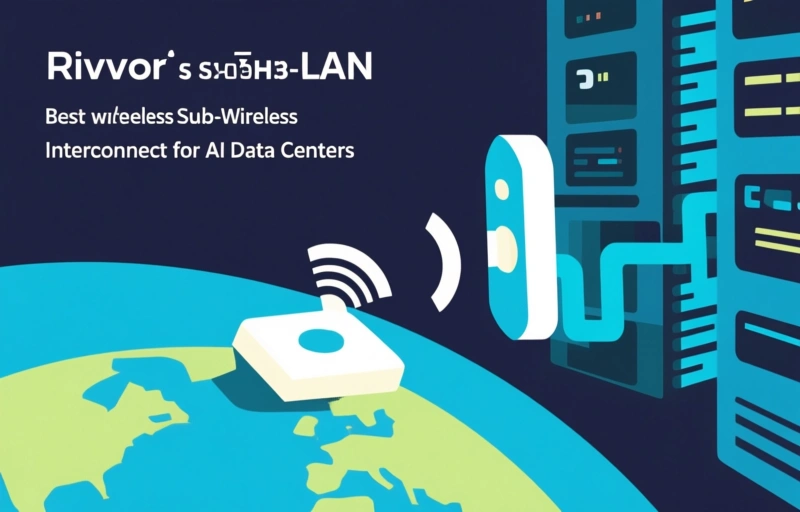
Rivvor's Sub-THz Wireless Interconnect for AI Data Centers
Sarah Mitchell ·
Listen to this article~3 min
Rivvor's sub-THz wireless interconnect promises blazing-fast, low-latency connections for AI data centers—on Earth and in orbit. A glimpse at the future of data infrastructure.
### The Next Leap in Data Center Connectivity
If you think your office Wi-Fi is impressive, wait until you see what Rivvor is cooking up. The company just unveiled a sub-THz wireless interconnect system designed specifically for AI data centers. And here's the kicker: it works both on Earth and in orbit.
We're talking about speeds that make fiber optics look like dial-up. This isn't your average network upgrade. It's a fundamental shift in how data centers talk to each other.
### What Makes Sub-THz Different?
Standard wireless signals operate in the gigahertz range. Sub-THz pushes into the hundreds of gigahertz. That's a whole different ballgame.
- **Massive bandwidth**: Think streaming entire AI model updates in seconds
- **Ultra-low latency**: Less than a millisecond for data transfers
- **Space-grade reliability**: It's built to survive rocket launches and vacuum
The technology uses the sub-terahertz spectrum, which sits between traditional microwave and infrared frequencies. Most consumer gadgets don't touch this range. But for AI workloads that demand instant data movement, it's a game changer.
### Why AI Data Centers Need This
AI training is hungry. Hungry for data, hungry for speed. When you're training a model with billions of parameters, every microsecond counts.
Traditional wired interconnects create bottlenecks. Cables get tangled, signal degrades over distance, and scaling becomes a nightmare. Rivvor's wireless solution cuts through all that.
> "Wireless interconnects aren't just convenient anymore. They're becoming essential for next-gen AI infrastructure."
Picture a data center with racks spread across a football field. With sub-THz wireless, they can communicate as if they were inches apart. No cables, no latency, no fuss.
### Built for Earth and Beyond
Here's where it gets wild. Rivvor engineered this system to work in orbit too. That means satellite constellations could act as a giant distributed data center.
Imagine an AI model trained across multiple satellites, all linked by sub-THz beams. It sounds like sci-fi, but the tech is real. The company has already tested prototypes in vacuum chambers and simulated space conditions.
### What This Means for the Industry
- **Lower costs**: No more running miles of fiber
- **Faster deployment**: Set up a wireless link in hours, not weeks
- **Greater flexibility**: Move racks without rewiring
For AI companies, this could slash training times from weeks to days. For satellite operators, it opens up on-orbit processing that was previously impossible.
### The Bottom Line
Rivvor is solving a problem most people don't even know exists. As AI models grow, the infrastructure supporting them has to evolve. Sub-THz wireless interconnects might be the backbone of tomorrow's internet.
And the fact that it works in space? That's just showing off. But in a good way.
*This article was originally published as a press release. Links have been updated for clarity.*