Subsea Wireless Breakthrough: Ocean to Satellite Broadband…
Sarah Mitchell ·
Listen to this article~5 min
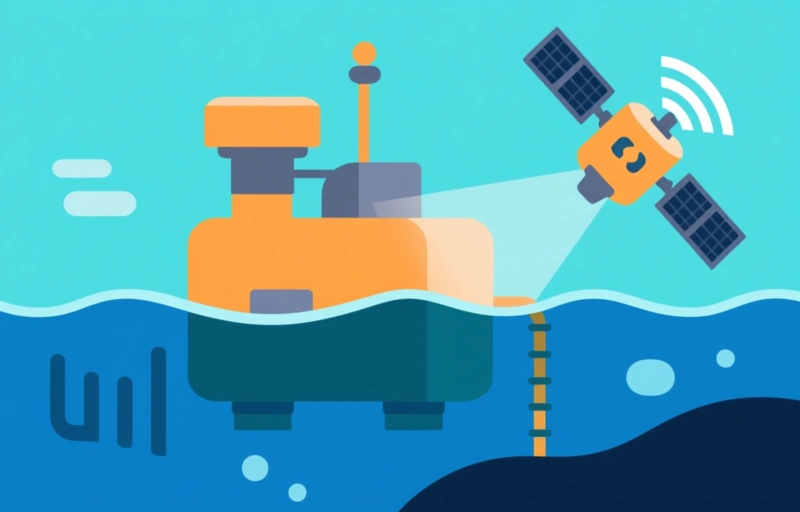
A groundbreaking demonstration shows how wireless broadband can now travel from deep underwater equipment directly to satellites, enabling real-time data from previously unreachable ocean depths.
### A Deep Dive Into Underwater Connectivity
You know how frustrating it is when your Wi-Fi drops for just a second? Now imagine trying to get a signal from 10,000 feet below the ocean's surface. That's the challenge a recent technology demonstration aimed to solve, and the results could reshape how we connect everything from offshore energy to deep-sea research.
It's not just about checking email underwater. This is about creating a seamless data highway from the seabed to space. Think of it like building a wireless bridge where the middle section is literally miles of seawater. The implications are huge for industries that operate in the most remote places on Earth.
### How Does Subsea-to-Satellite Actually Work?
Let's break this down without the engineering jargon. Traditional underwater communication uses cables or acoustic signals that are painfully slow—we're talking dial-up modem speeds. This new approach uses optical wireless technology to create a high-speed link from submerged equipment to a surface buoy.
From there, the data hops to satellites orbiting hundreds of miles above. It's like having a relay team where each runner specializes in a different environment. The technology handles the handoff between water, air, and space without dropping the baton.
Here's what makes this demonstration particularly interesting:
- It achieved data transmission through 650 feet of seawater
- The system maintained connection despite ocean currents and movement
- Real-time monitoring became possible for submerged equipment
- The entire chain remained wireless from seabed to satellite

### Why This Matters for American Industries
If you're working in oil and gas, offshore wind, or marine research, this changes your game completely. Currently, getting data from underwater sensors means waiting for a ship to physically retrieve hard drives or dealing with painfully slow updates. With this technology, you could monitor a deep-sea pipeline or wind turbine foundation in real time.
Consider the safety implications alone. Instead of sending divers down for inspections, you could have continuous sensor data streaming to engineers sitting comfortably in Houston or San Diego. The cost savings in operational downtime alone could be measured in millions of dollars annually.
As one industry observer noted, "This isn't just incremental improvement—it's a fundamental shift in how we think about ocean operations." The ability to maintain constant communication with submerged assets removes one of the biggest barriers to expanding offshore operations.

### The Road Ahead for Wireless Ocean Networks
This demonstration proves the concept works, but there's still work to be done. Scaling the technology for different depths, improving data rates, and ensuring reliability in storm conditions are the next challenges. The companies involved are already talking about commercial deployments within the next few years.
What's particularly exciting is how this could democratize ocean access. Smaller research institutions that can't afford massive cable-laying operations could deploy sensor networks. Environmental monitoring could become continuous rather than periodic. Even aquaculture operations could benefit from better connectivity.
The ocean covers 71% of our planet, yet we've barely scratched the surface of its connectivity potential. This technology demonstration suggests we might finally be ready to change that. It's not about replacing existing infrastructure but creating new possibilities where cables simply aren't practical.
### What This Means for Your Wireless Strategy
While most of us won't be deploying networks at 10,000-foot depths anytime soon, this breakthrough highlights an important trend: wireless boundaries are disappearing. If we can maintain broadband connections through miles of seawater, imagine what that means for challenging terrestrial environments.
The same principles driving this innovation—reliability in harsh conditions, seamless handoffs between different media, and real-time data integrity—are exactly what businesses need for their own wireless networks. Whether you're connecting sensors in a factory or devices across a campus, the lessons from this deep-sea demo apply.
Sometimes the most extreme environments produce the most universally useful technologies. This might just be one of those cases. The ocean has always been the final frontier for connectivity—and it looks like we're finally making some waves.