Wireless Breakthrough: 15 GB/s Chip Transceiver Dwarfs 5G…
Eleanor Vance ·
Listen to this article~4 min
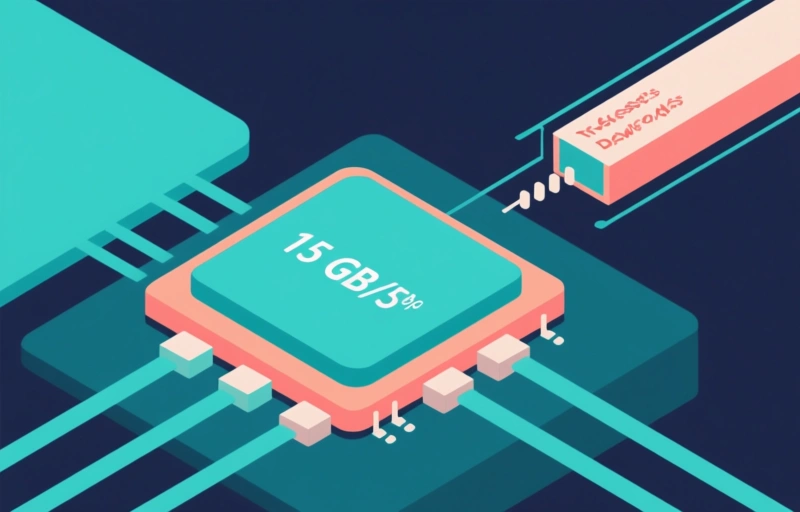
A new wireless transceiver chip achieves 15 GB/s, 24x faster than 5G, by directly converting digital data to analog signals. This breakthrough could redefine high-density network design and backhaul.
Let's talk about a piece of hardware that's about to change the game. You know how we're all getting used to 5G speeds? Well, researchers have just demoed something that makes current connections look like dial-up. I'm not exaggerating. We're looking at a new wireless transceiver that pushes data 24 times faster than today's 5G. That's a staggering 15 gigabytes per second. It's the kind of leap that doesn't happen often, and it's all built on a clever silicon chip.
What's the big deal, you ask? It's not just about raw speed, though that's impressive enough. It's about how they're doing it. This isn't just an incremental tweak to existing tech. They've rethought the fundamental process of sending and receiving signals.
### The Silicon Chip That Skips the Middleman
Traditionally, getting digital data ready for wireless transmission is a bit of a rigmarole. Your data has to go through a whole chain of conversions before it's finally beamed out as an analog radio wave. It's inefficient. It adds latency and complexity. This new chip cuts out the middleman entirely. It can directly send and receive analog signals from digital data. Think of it like having a direct phone line instead of going through a dozen switchboard operators.
That direct approach is a huge deal. It simplifies the architecture dramatically. Fewer components, less power consumption, and significantly reduced signal processing overhead. For us in the wireless LAN world, that translates to potential for incredibly dense, high-throughput networks without the usual power and heat penalties.
### What This Means for Wireless Professionals
So, what does a 15 GB/s wireless link mean for your next network design? Let's break it down.
- **Backhaul Revolution:** Imagine point-to-point links for stadiums, campuses, or ISP backhaul that don't need fiber trenches. The bandwidth is there.
- **Density Support:** With this throughput, a single access point could theoretically handle hundreds of simultaneous 8K video streams. The concept of client density gets rewritten.
- **Latency Crushing:** Direct conversion means less processing delay. For real-time applications—think industrial IoT, pro AV, or AR/VR—this is potentially transformative.
It's easy to get lost in the big numbers. But the real story is the integration. Packing this performance into a single, efficient silicon chip is what makes it practical, not just a lab curiosity.
As one researcher involved put it, *"We're not just improving the highway; we're building a whole new type of vehicle that can travel on any terrain."* That's the mindset shift here. It's a foundational technology that could enable applications we haven't even dreamed up yet.
Of course, we're not installing these in clients tomorrow. It's a research demonstration. The path from lab prototype to standardized, cost-effective silicon is a long one. There are regulatory hurdles, ecosystem development, and all the usual engineering challenges of mass production.
But the direction is clear. The demand for wireless bandwidth is insatiable, and innovations like this direct-conversion transceiver are the only way we'll keep up. It reminds us that sometimes, the biggest leaps come from going back to basics and asking a simple question: 'Why do we do it this way?' When the answer is 'Because we always have,' that's when a breakthrough is waiting to happen. For network architects, it's a thrilling glimpse of the toolbox we'll have in the coming decade.